
Revêtement conforme étapes du processus
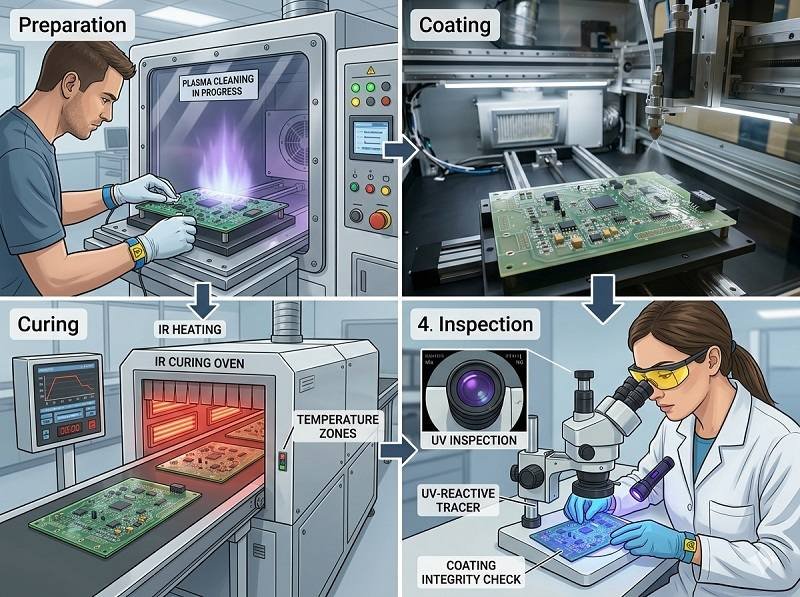
En Assemblage du circuit imprimé et Assemblage SMT, le Revêtement conforme Le processus d'application du revêtement suit une série d'étapes contrôlées afin de garantir une protection fiable contre l'humidité, la poussière, les produits chimiques et les contraintes environnementales. L'exécution correcte de chaque étape est essentielle pour la performance du revêtement et sa durabilité à long terme.
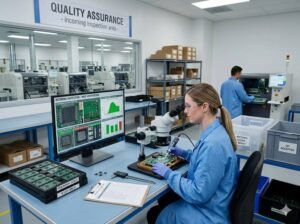
Inspection avant revêtement
Avant d'appliquer Revêtement conforme, le circuit imprimé doit être soigneusement inspecté.
- Vérifier qu'il n'y a pas de défauts de soudure, de contamination ou de dommages
- S'assurer que tous les composants sont correctement assemblés
- Vérifier que le conseil répond aux normes de qualité
Tout défaut laissé avant l'application du revêtement peut devenir difficile à réparer plus tard dans la vie de l'entreprise. Assemblage du circuit imprimé.
Nettoyage de la carte de circuit imprimé
Le nettoyage est l'une des étapes les plus importantes de l'élaboration d'un plan d'action. Revêtement conforme processus.
- Élimine les résidus de flux, les huiles, les poussières et les contaminants ioniques.
- Utiliser un nettoyage au solvant, un nettoyage aqueux ou un nettoyage par ultrasons.
- Veiller à ce que la surface soit chimiquement propre pour assurer une bonne adhérence.
Un mauvais nettoyage peut entraîner une défaillance du revêtement, une délamination ou une corrosion.
Séchage et élimination de l'humidité
Après le nettoyage, la carte de circuit imprimé doit être complètement sèche.
- Utiliser des fours ou un séchage à l'air pour éliminer l'humidité résiduelle.
- Empêcher l'humidité de s'infiltrer sous le revêtement
Cette étape est essentielle pour Assemblage SMT pour éviter les problèmes de fiabilité à long terme.
Masquage
Le masquage protège les zones qui ne doivent pas être recouvertes.
- Connecteurs, interrupteurs, points d'essai et prises de courant
- Utiliser des rubans, des bottes ou des masques amovibles
Un masquage précis garantit que la fonctionnalité n'est pas affectée après l'utilisation de l'appareil. Revêtement conforme.
Application du revêtement
Les Revêtement conforme est ensuite appliquée en utilisant l'une des méthodes suivantes :
- Revêtement par pulvérisation (manuel ou automatisé)
- Revêtement par immersion
- Revêtement au pinceau (pour réparation ou faible volume)
- Revêtement sélectif (précision automatisée)
- Dépôt en phase vapeur (pour les revêtements en parylène)
Le choix dépend de l'échelle de production et des exigences du produit. Assemblage du circuit imprimé.
Durcissement
Après application, le revêtement doit être durci pour former une couche protectrice.
- Cure d'air (commun pour l'acrylique)
- Guérison par la chaleur (époxy, polyuréthane)
- Durcissement aux UV (rapide et efficace)
- Cure d'humidité (revêtements en silicone)
Un durcissement adéquat permet au revêtement d'atteindre ses propriétés mécaniques et électriques.
Inspection et contrôle de la qualité
Une fois durci, le revêtement est inspecté pour en garantir la qualité.
- Contrôle visuel sous lumière blanche ou UV
- Vérifier la couverture, l'épaisseur, la présence de bulles ou de vides
- Vérifier qu'aucune zone non désirée n'est recouverte
Les systèmes d'inspection automatisés sont souvent utilisés dans les Assemblage SMT lignes.
Essais et validation
Les tests finaux permettent de s'assurer que le circuit imprimé revêtu répond aux exigences de performance.
- Essais électriques
- Essais environnementaux (humidité, cycles de température)
- Contrôle de l'adhérence et de l'épaisseur
Cette étape permet de confirmer la fiabilité dans des conditions d'utilisation réelles.
Conclusion finale
Les Revêtement conforme processus en Assemblage du circuit imprimé et Assemblage SMT comprend l'inspection, le nettoyage, le séchage, le masquage, l'application du revêtement, le durcissement et l'inspection finale. Chaque étape joue un rôle essentiel pour garantir que le revêtement offre une protection efficace et durable aux circuits électroniques.
Obtenir un devis pour un revêtement conforme
Vous avez besoin d'un délai d'exécution rapide pour vos projets de revêtement conforme ? Soumettez votre demande dès aujourd'hui.
Envoyez-nous vos exigences et obtenez une réponse rapide de notre équipe d'ingénieurs.
✔ Réponse dans les 24 heures ✔ Soutien technique ✔ Production en petite et grande série
Shenzhen Tengxinjie Electronics Co. Ltd.
 Français
  English
  Deutsch
  Português do Brasil
  Español
  日本語
日本語  Nederlands
  Italiano
  Русский
  한국어
한국어  العربية
  Svenska
  Polski
  Türkçe
  繁體中文
繁體中文