
revêtement pour PCB LED
Les circuits imprimés à LED sont largement utilisés dans les systèmes d'éclairage tels que les lampadaires, l'éclairage automobile et les luminaires intérieurs/extérieurs. Ces applications impliquent souvent une production de chaleur, une exposition à l'humidité et de longues heures de fonctionnement. Par conséquent, le choix du bon Revêtement conforme est essentielle dans Assemblage du circuit imprimé et Assemblage SMT pour garantir la performance et la longévité.
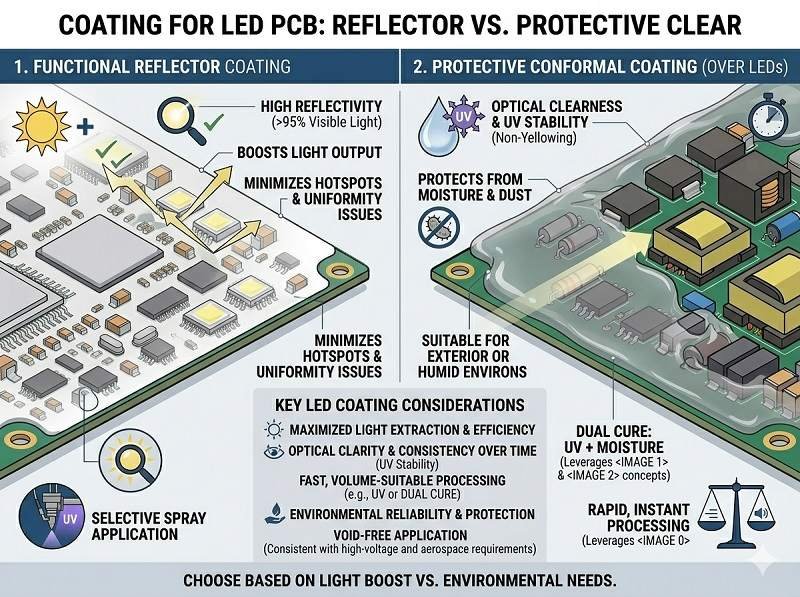
Revêtements les plus couramment utilisés pour les circuits imprimés à LED
Il n'existe pas de solution unique, mais les revêtements suivants sont les plus couramment utilisés dans les LED Assemblage du circuit imprimé:
Revêtement conforme en silicone (choix le plus populaire)
Silicone Revêtement conforme est l'option la plus répandue pour les circuits imprimés de DEL.
Pourquoi le silicone est préférable :
- Excellent stabilité thermique (gère les températures de fonctionnement élevées des LED)
- Flexible → résiste aux fissures dues aux cycles thermiques
- Bon résistance à l'humidité pour l'éclairage extérieur
- Maintien des performances sur une longue durée de vie
Comme les LED génèrent de la chaleur en permanence, la capacité du silicone à résister à des températures élevées en fait un matériau idéal pour les LED. Assemblage SMT.
Revêtement conforme acrylique (option économique)
Acrylique Revêtement conforme est souvent utilisé dans les produits LED sensibles aux coûts.
- Faible coût et facilité d'application
- Temps de séchage rapide
- Facile à retravailler et à réparer
Cependant, sa résistance à la température et à l'humidité est inférieure à celle du silicone, ce qui le rend plus adapté aux applications d'éclairage intérieur.
Revêtement en polyuréthane (pour les environnements difficiles)
Les revêtements en polyuréthane sont utilisés lorsque les circuits imprimés à LED sont exposés à.. :
- Conditions météorologiques extérieures
- Produits chimiques ou polluants
- Humidité élevée
Ils offrent une forte protection de l'environnement mais sont moins flexibles que le silicone.
Revêtement en parylène (applications haut de gamme)
Le parylène est utilisé dans les applications LED haut de gamme ou critiques.
- Protection ultra-mince et uniforme
- Excellente résistance à l'humidité et à la corrosion
- Grande fiabilité dans les environnements extrêmes
En raison de son coût plus élevé, il est généralement utilisé dans des applications spécialisées. Assemblage de circuits imprimés clés en main plutôt que des produits d'éclairage standard.
Principales considérations pour le revêtement des circuits imprimés de LED
Lors de la sélection d'un Revêtement conforme pour les circuits imprimés à LED, à considérer :
- Dissipation de la chaleur: Le revêtement doit supporter des températures élevées
- Exposition aux UV: Les LED d'extérieur nécessitent des revêtements résistants aux UV
- Protection contre l'humidité: Particulièrement pour l'éclairage des rues et des paysages
- Clarté optique: Le revêtement ne doit pas affecter le rendement lumineux ou la couleur
Dans le domaine professionnel Assemblage du circuit imprimé, les revêtements sont souvent appliqués de manière sélective pour éviter de recouvrir les lentilles des LED ou les surfaces optiques.
Conclusion
Le revêtement le plus couramment utilisé pour les circuits imprimés à LED est le suivant revêtement conforme en silicone, L'acrylique est une solution économique pour une utilisation en intérieur, tandis que le polyuréthane et le parylène sont choisis pour des environnements plus exigeants. L'acrylique est une alternative économique pour une utilisation en intérieur, tandis que le polyuréthane et le parylène sont choisis pour des environnements plus exigeants. Dans les pays de l'Union européenne, l'acrylique est une alternative économique pour une utilisation en intérieur. Assemblage du circuit imprimé, Assemblage SMT, et Assemblage de circuits imprimés clés en main, Le revêtement adéquat garantit des performances fiables et prolonge la durée de vie des produits LED.
Obtenir un devis pour un revêtement conforme
Vous recherchez des solutions fiables de revêtement conforme pour votre projet PCBA ? Cliquez ci-dessous pour obtenir un devis rapide.
Envoyez-nous vos exigences et obtenez une réponse rapide de notre équipe d'ingénieurs.
✔ Réponse dans les 24 heures ✔ Soutien technique ✔ Production en petite et grande série
Shenzhen Tengxinjie Electronics Co. Ltd.




 Français
  English
  Deutsch
  Português do Brasil
  Español
  日本語
日本語  Nederlands
  Italiano
  Русский
  한국어
한국어  العربية
  Svenska
  Polski
  Türkçe
  繁體中文
繁體中文