
Revêtement conforme matériel
Choisir le bon Revêtement conforme est essentiel pour garantir la fiabilité et les performances des produits électroniques. Au cours de l'année Assemblage du circuit imprimé et Assemblage SMT, Les propriétés des revêtements varient en fonction de l'environnement et des exigences de l'application. Le choix d'un mauvais matériau peut entraîner une mauvaise protection, une réduction de la durée de vie ou des coûts inutiles.
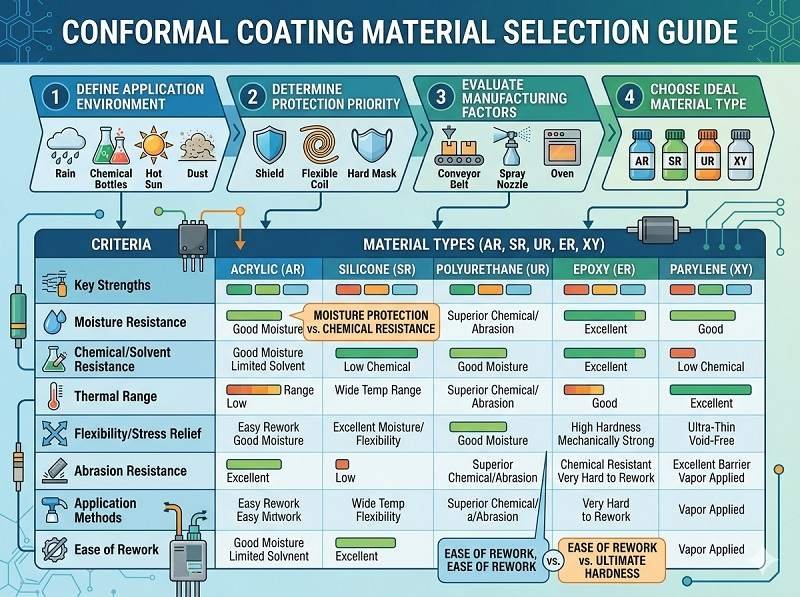
Tenir compte de l'environnement opérationnel
La première étape de la sélection d'un Revêtement conforme est de comprendre où le produit sera utilisé.
- Forte humidité ou exposition à l'eau → Choisir des revêtements ayant une forte résistance à l'humidité (par exemple, silicone, acrylique)
- Exposition chimique → Les revêtements en polyuréthane ou en époxy offrent une meilleure résistance chimique
- Températures extrêmes → Les revêtements en silicone résistent bien aux contraintes thermiques
- Environnements extérieurs ou difficiles → Envisager des options de haute performance comme le parylène
En Assemblage du circuit imprimé, L'adaptation du revêtement aux conditions environnementales est essentielle pour une fiabilité à long terme.
Évaluer les besoins de protection
Des applications différentes nécessitent des niveaux de protection différents.
- Pour une protection de base contre la poussière et l'humidité, l'acrylique Revêtement conforme est souvent suffisante
- Pour une protection renforcée, par exemple dans l'industrie ou l'automobile Assemblage SMT, Le polyuréthane ou l'époxy peuvent être plus appropriés.
- Pour les applications critiques (médicales, aérospatiales), le parylène offre des performances supérieures.
Comprendre le niveau de protection nécessaire permet d'éviter de sur-spécifier ou de sous-protéger votre conception.
Tenir compte des besoins de reprise et de réparation
Certains revêtements sont plus faciles à enlever que d'autres.
- Facile à retravailler → Revêtements acryliques
- Difficulté moyenne → Revêtements en silicone
- Difficile à enlever → Revêtements en polyuréthane et en époxy
Si votre Assemblage du circuit imprimé nécessite des modifications ou des réparations fréquentes, le choix d'un produit facile à retravailler est essentiel. Revêtement conforme est importante.
Évaluer la méthode d'application
La méthode de revêtement utilisée dans les Assemblage SMT peut influencer le choix des matériaux.
- Revêtement par pulvérisation → Fonctionne bien avec l'acrylique et le silicone
- Revêtement par immersion → Convient pour une couverture uniforme avec différents matériaux
- Revêtement au pinceau → Idéal pour les réparations ou les applications à petite échelle
- Dépôt de parylène → Nécessité d'un équipement de vide spécialisé
La compatibilité avec votre processus de production garantit l'efficacité et la cohérence des résultats.
Considérations thermiques et mécaniques
Les assemblages électroniques sont souvent soumis à des changements de température et à des contraintes mécaniques.
- Les revêtements flexibles (comme le silicone) supportent mieux les vibrations et la dilatation thermique.
- Les revêtements rigides (comme l'époxy) offrent une protection mécanique plus forte mais peuvent se fissurer sous l'effet de la contrainte.
L'équilibre entre la flexibilité et la force est essentiel pour Assemblage du circuit imprimé la conception.
Facteurs de coût et de production
Le budget et l'échelle de fabrication jouent également un rôle.
- Les revêtements acryliques sont rentables pour les applications à grande échelle. Assemblage SMT
- Le parylène offre des performances de haut niveau, mais à un coût plus élevé.
- L'époxy et le polyuréthane se situent dans une fourchette moyenne à élevée, en fonction des besoins.
Choisir le bon matériau, c'est trouver un équilibre entre performance et rentabilité.
Obtenir un devis pour un revêtement conforme
Vous avez des questions sur le revêtement conforme de votre circuit imprimé ? Nos ingénieurs sont prêts à vous aider.
Envoyez-nous vos exigences et obtenez une réponse rapide de notre équipe d'ingénieurs.
✔ Réponse dans les 24 heures ✔ Soutien technique ✔ Production en petite et grande série
Shenzhen Tengxinjie Electronics Co. Ltd.

 Français
  English
  Deutsch
  Português do Brasil
  Español
  日本語
日本語  Nederlands
  Italiano
  Русский
  한국어
한국어  العربية
  Svenska
  Polski
  Türkçe
  繁體中文
繁體中文