
Matériaux de revêtement conforme
Dans la fabrication de produits électroniques, Revêtement conforme sont sélectionnés en fonction du niveau de protection requis, des conditions environnementales et des besoins de traitement. Qu'il s'agisse de Assemblage du circuit imprimé, Prototype d'assemblage de circuits imprimés, ou Assemblage SMT, Le choix du bon matériau de revêtement est essentiel pour garantir la fiabilité et les performances à long terme.
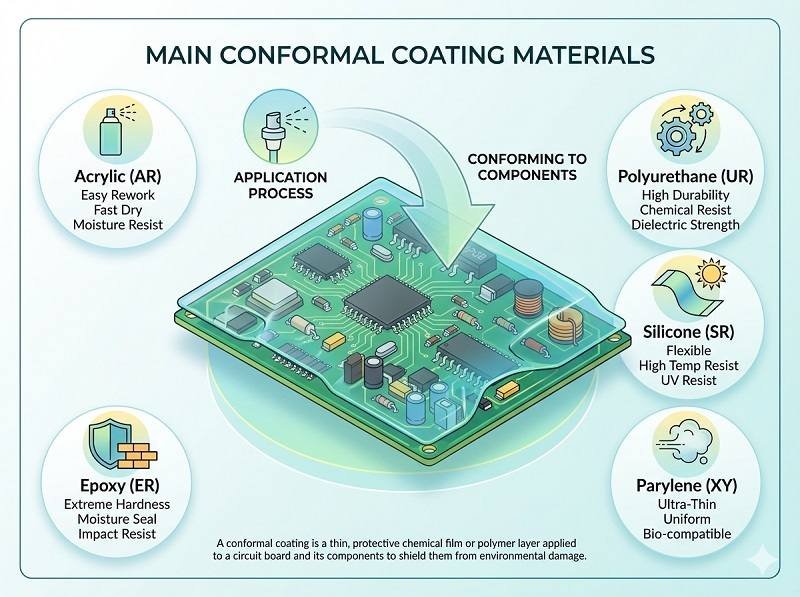
Il existe plusieurs types principaux de matériaux de revêtement conforme, chacun ayant des propriétés et des avantages uniques :
Acrylique (AR)
Les revêtements acryliques sont l'un des matériaux les plus couramment utilisés dans les domaines suivants Assemblage du circuit imprimé. Elles offrent une bonne résistance à l'humidité, sont faciles à appliquer et peuvent être retirées pour être retravaillées ou réparées. Les acryliques sèchent également rapidement, ce qui les rend idéales pour les travaux de grande envergure. Assemblage SMT processus. Toutefois, leur résistance aux solvants et aux environnements extrêmes est relativement limitée.
Silicone (SR)
Les revêtements en silicone sont connus pour leur excellente flexibilité et leurs performances à des températures extrêmes. Ils peuvent résister à la fois à la chaleur et au froid, ce qui les rend appropriés pour l'automobile, l'aérospatiale et l'électronique d'extérieur. En Prototype d'assemblage de circuits imprimés, Le silicone est souvent testé pour des applications nécessitant une durabilité en cas de stress thermique et d'humidité élevée.
Polyuréthane (UR)
Les revêtements en polyuréthane offrent une forte résistance aux produits chimiques, à l'abrasion et aux solvants. Ils sont couramment utilisés dans les environnements industriels et difficiles où l'on s'attend à une exposition aux carburants, aux huiles ou aux substances corrosives. Cependant, ils sont plus difficiles à enlever, ce qui peut compliquer les travaux de réfection dans des environnements difficiles. Assemblage du circuit imprimé.
Epoxy (ER)
Les revêtements époxy offrent une excellente résistance mécanique et chimique. Ils forment une couche dure et durable qui protège contre les conditions environnementales difficiles. Toutefois, leur rigidité peut être un inconvénient dans les applications présentant une dilatation thermique et, comme le polyuréthane, ils sont difficiles à enlever une fois durcis.
Parylène (XY)
Le parylène est un revêtement conforme unique appliqué par un processus de dépôt de vapeur plutôt que par pulvérisation ou brossage. Il crée un revêtement অত্যmince, uniforme et sans trou d'épingle qui offre une protection exceptionnelle contre l'humidité, les produits chimiques et la rupture diélectrique. Bien que très efficace, le revêtement au parylène est plus coûteux et nécessite un équipement spécialisé, ce qui le rend moins courant dans les applications standard. Assemblage SMT mais précieux dans les applications à haute fiabilité telles que les appareils médicaux et aérospatiaux.
Chaque matériau varie en termes d'épaisseur, de flexibilité, de résistance chimique et de facilité d'application. Au cours de l'année Prototype d'assemblage de circuits imprimés, les ingénieurs évaluent souvent plusieurs matériaux afin de déterminer celui qui convient le mieux à l'environnement d'exploitation du produit.
En conclusion, le choix des Revêtement conforme Le choix du matériau dépend des exigences spécifiques de l'application. Des acryliques économiques au parylène haute performance, le choix du bon matériau garantit une protection et une longévité optimales dans les domaines suivants Assemblage du circuit imprimé, Assemblage SMT, et Prototype d'assemblage de circuits imprimés.
Obtenir un devis pour un revêtement conforme
Vous n'êtes pas sûr du revêtement conforme qui convient à votre produit ? Contactez nos experts dès aujourd'hui.
Envoyez-nous vos exigences et obtenez une réponse rapide de notre équipe d'ingénieurs.
✔ Réponse dans les 24 heures ✔ Soutien technique ✔ Production en petite et grande série
Shenzhen Tengxinjie Electronics Co. Ltd.




 Français
  English
  Deutsch
  Português do Brasil
  Español
  日本語
日本語  Nederlands
  Italiano
  Русский
  한국어
한국어  العربية
  Svenska
  Polski
  Türkçe
  繁體中文
繁體中文