
Enrobage et encapsulation
Dans le domaine de la protection électronique, les deux Revêtement conforme et l'encapsulation (également connue sous le nom de potting) sont utilisés pour protéger les circuits imprimés. Cependant, ils diffèrent considérablement en termes de structure, d'application et de performance. Il est essentiel de comprendre ces différences pour Assemblage du circuit imprimé, Prototype d'assemblage de circuits imprimés, et Assemblage SMT pour choisir la bonne méthode de protection.
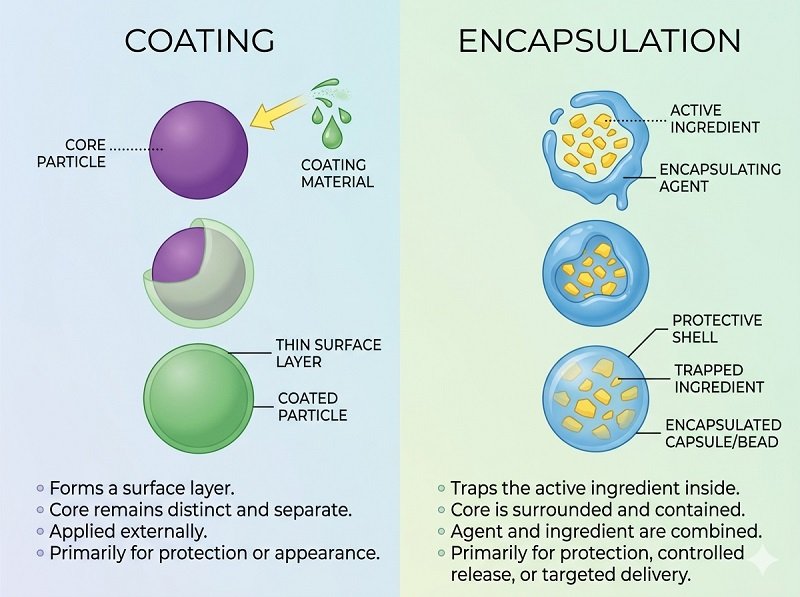
Revêtement conforme est un fine couche de protection (généralement 25-250 µm) appliquée directement sur la surface d'un circuit imprimé. Il “épouse” les contours des composants, offrant une protection contre l'humidité, la poussière, les produits chimiques et les variations de température. Comme il est fin et léger, il n'affecte pas de manière significative la taille ou le poids de la carte. C'est pourquoi il constitue un choix de prédilection dans les domaines suivants Assemblage du circuit imprimé où l'espace et la possibilité de retravailler sont importants.
L'encapsulation, quant à elle, implique recouvrir ou encastrer complètement la carte de circuits imprimés dans une résine épaisse ou un gel (époxy, silicone ou polyuréthane, par exemple). Le matériau forme un bloc solide ou semi-solide autour de l'électronique, créant une barrière solide contre l'eau, les chocs, les vibrations et les produits chimiques agressifs. Cette méthode est couramment utilisée dans les environnements extrêmement exigeants où une protection maximale est requise.
L'une des plus grandes différences réside dans épaisseur et couverture. Tout en Revêtement conforme est un film fin qui permet de voir et d'accéder aux composants, l'encapsulation est beaucoup plus épaisse et scelle complètement la carte, ce qui rend l'inspection et la réparation presque impossibles. En Assemblage SMT, Le revêtement conforme est souvent préféré parce qu'il permet de retravailler et d'entretenir plus facilement les cartes à forte densité de population.
Une autre différence essentielle est réparabilité. Les revêtements conformes peuvent généralement être enlevés ou retravaillés en cas de défaillance d'un composant, ce qui est particulièrement utile lors de l'application d'un revêtement conforme. Prototype d'assemblage de circuits imprimés et de développement de produits. Cependant, l'encapsulation est généralement permanente : une fois la carte encapsulée, il est extrêmement difficile d'accéder aux composants internes sans endommager l'assemblage.
En termes de niveau de protection, L'encapsulation offre une résistance supérieure à l'eau (y compris à l'immersion totale), aux contraintes mécaniques et aux risques environnementaux. Le revêtement conforme offre une excellente protection contre l'humidité et les contaminants, mais n'est pas totalement étanche ou mécaniquement robuste par rapport à l'encapsulation.
Le coût et le traitement diffèrent également. Le revêtement conforme est généralement plus rapide, plus rentable et plus facile à intégrer dans les processus de production standard. Assemblage du circuit imprimé processus. L'encapsulation nécessite plus de matériaux, des temps de durcissement plus longs et une manipulation spécialisée, ce qui augmente le coût et la complexité de la production.
En résumé, Revêtement conforme est idéal pour les applications nécessitant une protection légère, rentable et réparable, tandis que l'encapsulation convient aux environnements extrêmes où une durabilité et une étanchéité maximales sont nécessaires. Le choix entre les deux dépend des conditions de fonctionnement du produit, des exigences de fiabilité et des priorités de fabrication.
Obtenir un devis pour un revêtement conforme
Besoin d'une assistance professionnelle pour le revêtement conforme ? Soumettez vos besoins et obtenez une réponse dans les 12 heures.
Envoyez-nous vos exigences et obtenez une réponse rapide de notre équipe d'ingénieurs.
✔ Réponse dans les 24 heures ✔ Soutien technique ✔ Production en petite et grande série
Shenzhen Tengxinjie Electronics Co. Ltd.



 Français
  English
  Deutsch
  Português do Brasil
  Español
  日本語
日本語  Nederlands
  Italiano
  Русский
  한국어
한국어  العربية
  Svenska
  Polski
  Türkçe
  繁體中文
繁體中文