
Coating defects
Defects in الطلاء المطابق can significantly reduce the protection and reliability of electronic products. In تجميع ثنائي الفينيل متعدد الكلور, تجميع النموذج الأولي لثنائي الفينيل متعدد الكلور, و تجميع SMT, coating defects may lead to corrosion, electrical leakage, poor insulation, or mechanical failure. Understanding the root causes is essential for improving process quality and minimizing rework.
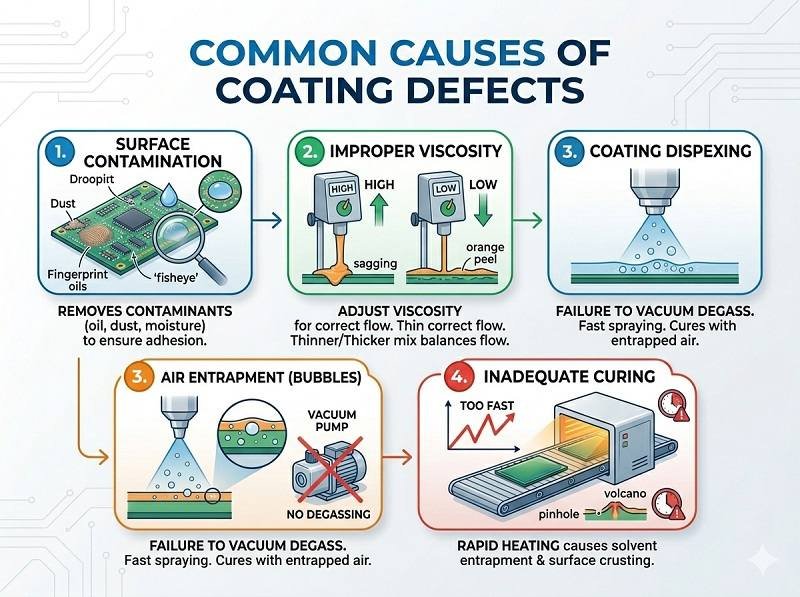
Poor surface cleaning
One of the most common causes of coating defects is contamination on the PCB surface. Residues such as flux, oils, dust, or fingerprints can prevent proper adhesion of the الطلاء المطابق, leading to issues like delamination, pinholes, or uneven coverage. Proper cleaning and drying are critical steps in تجميع ثنائي الفينيل متعدد الكلور.
Moisture and outgassing
Moisture trapped in the PCB or components can evaporate during curing, forming bubbles or voids in the coating. In تجميع SMT, improper storage or lack of pre-baking can increase moisture absorption, resulting in defects.
Incorrect coating thickness
Applying the coating too thin may result in incomplete protection, while excessive thickness can cause cracking, bubbling, or long curing times. Maintaining a consistent thickness is essential for reliable performance in تجميع ثنائي الفينيل متعدد الكلور.
Improper application method
Spraying, dipping, or brushing parameters must be carefully controlled. Incorrect spray pressure, nozzle distance, or uneven manual application can lead to defects such as streaks, runs, or uneven coverage. Automated systems in تجميع SMT help improve consistency but still require proper setup.
Air entrapment and bubbles
Air introduced during mixing or application can become trapped in the coating. This leads to bubbles or voids, which weaken the protective barrier and reduce insulation performance.
Inadequate curing conditions
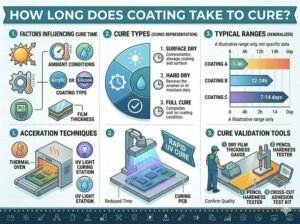
Improper curing—whether too fast, too slow, or at the wrong temperature—can result in incomplete polymerization, soft coatings, or cracking. In UV coatings, insufficient exposure can leave uncured areas, especially under components in dense تجميع SMT التصاميم.
Poor adhesion or surface compatibility
Certain PCB materials or finishes may not bond well with specific coatings. Without proper surface preparation or compatibility testing in تجميع النموذج الأولي لثنائي الفينيل متعدد الكلور, adhesion failures may occur.
Environmental factors during application
Dust, humidity, and temperature fluctuations in the production environment can affect coating quality. High humidity, for example, can cause blushing or reduced insulation performance.
Masking errors
Incorrect masking can lead to coating contamination on connectors or keep-out areas, causing functional issues or requiring additional rework.
Material quality and handling
Expired or improperly stored coating materials may degrade, leading to inconsistent performance. Proper storage and handling are essential in all تجميع ثنائي الفينيل متعدد الكلور العمليات.
In conclusion, coating defects are usually caused by a combination of surface contamination, process control issues, environmental conditions, and material selection. By carefully managing these factors during تجميع ثنائي الفينيل متعدد الكلور, تجميع SMT, و تجميع النموذج الأولي لثنائي الفينيل متعدد الكلور, manufacturers can significantly reduce defects and ensure high-quality الطلاء المطابق performance.
احصل على عرض أسعار الطلاء المطابق
احصل على مشورة الخبراء والأسعار المناسبة لاحتياجاتك من الطلاء المطابق اليوم.
أرسل لنا متطلباتك واحصل على استجابة سريعة من فريقنا الهندسي.
✔ استجابة على مدار 24 ساعة ✔ دعم هندسي ✔ دعم هندسي ✔ إنتاج صغير وضخم
شركة Shenzhen Tengxinjie Electronics Co., Ltd.
 العربية
  English
  Deutsch
  Français
  Português do Brasil
  Español
  日本語
日本語  Nederlands
  Italiano
  Русский
  한국어
한국어  Svenska
  Polski
  Türkçe
  繁體中文
繁體中文