
الطلاء المطابق and potting
In electronics manufacturing, both Conformal Coating and potting are widely used to protect circuit boards during تجميع ثنائي الفينيل متعدد الكلور و تجميع SMT. While they serve similar purposes—protecting electronics from environmental damage—their methods, materials, and applications are significantly different.
What is الطلاء المطابق
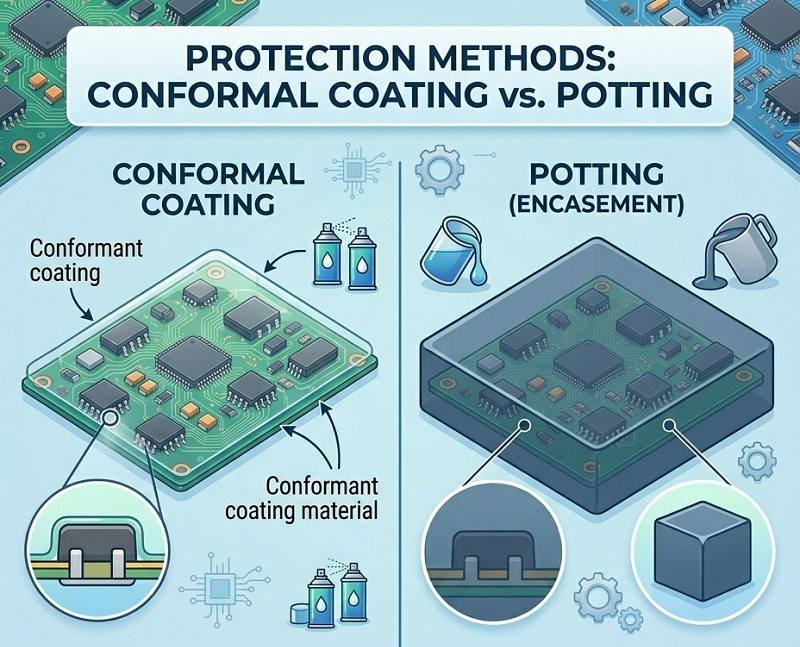
الطلاء المطابق is a thin, protective polymer layer applied directly to the surface of a printed circuit board. It “conforms” to the contours of components, creating a lightweight barrier against moisture, dust, chemicals, and temperature variations.
Because the layer is thin (typically 25–250 microns), it does not add significant weight or size to the board. This makes it ideal for compact and high-density designs in تجميع SMT. Additionally, coated boards can still be repaired or reworked if necessary, depending on the coating type.
What is Potting
Potting, also known as encapsulation, involves fully enclosing a PCB or electronic assembly in a solid or gel-like compound, such as epoxy, silicone, or polyurethane resin. Instead of a thin layer, the entire component or board is submerged and sealed within a protective material.
Potting provides a much thicker and more robust level of protection compared to الطلاء المطابق, making it suitable for extremely harsh environments. However, once potted, the electronics are usually impossible to repair or rework.
Key Differences
Protection Level
Potting offers superior protection against moisture, vibration, shock, and chemicals because the entire assembly is encapsulated. الطلاء المطابق provides effective protection but is designed for moderate environmental conditions.
Thickness and Weight
الطلاء المطابق is thin and lightweight, making it suitable for space-constrained designs. Potting adds significant bulk and weight, which may not be suitable for all applications.
Rework and Repair
Boards with الطلاء المطابق can often be repaired or modified. In contrast, potted assemblies are typically permanent, making rework nearly impossible.
Thermal Management
الطلاء المطابق allows better heat dissipation due to its thin layer. Potting can either help or hinder thermal performance depending on the material used, but it often traps heat if not properly designed.
Cost and Processing
الطلاء المطابق is generally more cost-effective and faster to apply during تجميع ثنائي الفينيل متعدد الكلور. Potting involves more material and longer curing times, increasing overall production cost.
When to Choose Each Method
الطلاء المطابق is ideal for consumer electronics, telecommunications, and applications where size, weight, and serviceability matter. It is commonly used in تجميع SMT lines for efficient, scalable production.
Potting is better suited for harsh environments such as automotive, marine, military, or industrial equipment, where maximum protection is required and repair is not a priority.
الخاتمة
Both الطلاء المطابق and potting are essential protection methods in تجميع ثنائي الفينيل متعدد الكلور و تجميع SMT, but they serve different needs. الطلاء المطابق offers lightweight, flexible protection with the advantage of reworkability, while potting provides maximum durability and environmental resistance at the cost of size, weight, and serviceability. Choosing the right solution depends on your application requirements, operating environment, and budget.
احصل على عرض أسعار الطلاء المطابق
From SMT assembly to conformal coating, we offer one-stop solutions. Get a quote now.
Send us your requirements and get a fast response from our engineering team.
✔ 24-hour response ✔ Engineering support ✔ Small & Mass Production
شركة Shenzhen Tengxinjie Electronics Co., Ltd.
 العربية
  English
  Deutsch
  Français
  Português do Brasil
  Español
  日本語
日本語  Nederlands
  Italiano
  Русский
  한국어
한국어  Svenska
  Polski
  Türkçe
  繁體中文
繁體中文