
Quality control process
A robust quality control process is essential in delivering reliable تجميع ثنائي الفينيل متعدد الكلور, تجميع SMT, و تجميع ثنائي الفينيل متعدد الكلور services. Quality is not just a final inspection step—it is built into every stage of تصنيع ثنائي الفينيل متعدد الكلور, from component sourcing to final shipment.
A professional manufacturer implements a comprehensive, multi-stage quality control system to ensure consistency, performance, and compliance with international standards.
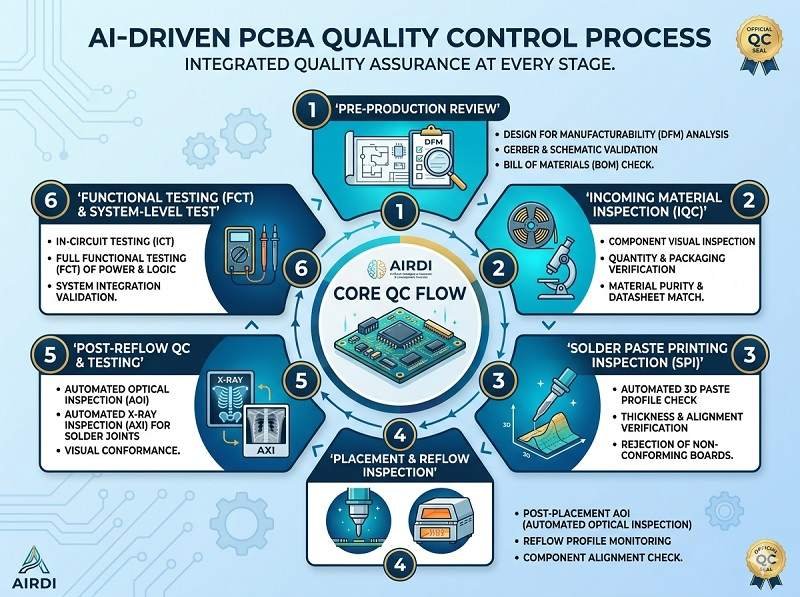
مراقبة الجودة الواردة (IQC)
Quality control begins before production starts.
During IQC, all incoming materials and components are carefully inspected:
- Verification of component authenticity and supplier documentation
- Checking part numbers, specifications, and quantities against the BOM
- Visual inspection for damage, oxidation, or packaging issues
- Moisture-sensitive component (MSD) handling checks
This step ensures that only qualified materials enter the تجميع SMT العملية.
Solder paste inspection (SPI)
Before component placement, solder paste application is verified using SPI systems.
This includes:
- Measuring solder paste volume, height, and alignment
- Detecting insufficient or excessive paste
- Ensuring accurate stencil printing
Proper solder paste deposition is critical for achieving strong and reliable solder joints in تجميع ثنائي الفينيل متعدد الكلور.
SMT placement process control
أثناء تجميع SMT, high-precision machines place components onto the PCB.
Quality control at this stage includes:
- Machine calibration and program verification
- فحص المادة الأولى (FAI)
- Real-time monitoring of placement accuracy
- Feeder and component verification
These controls ensure that components are correctly placed before soldering.
Reflow soldering control
The reflow process is tightly controlled to ensure proper soldering.
Key factors include:
- Temperature profile optimization
- Thermal consistency across the board
- Prevention of defects such as tombstoning or cold joints
Stable reflow conditions are essential for high-quality تصنيع ثنائي الفينيل متعدد الكلور.
الفحص البصري الآلي (AOI)
After reflow, AOI systems inspect the assembled boards.
AOI detects:
- Missing or misaligned components
- Solder bridges and insufficient solder
- Polarity errors
- Surface defects
This is a critical step in identifying defects early in the تجميع ثنائي الفينيل متعدد الكلور العملية.
الفحص بالأشعة السينية
For complex components such as BGAs and QFNs, X-ray inspection is used.
It allows:
- Inspection of hidden solder joints
- Detection of voids and internal defects
- Verification of solder quality beneath components
This ensures reliability in advanced تجميع SMT التطبيقات.
الاختبار داخل الدائرة (ICT)
ICT verifies the electrical performance of the assembled PCB.
It checks:
- Component values and functionality
- Circuit continuity and isolation
- Shorts and open circuits
ICT is widely used in mass production تجميع ثنائي الفينيل متعدد الكلور to ensure electrical correctness.
Functional testing (FCT)
Functional testing validates that the final product works as intended.
This includes:
- Simulating real operating conditions
- Testing product behavior and performance
- Verifying firmware and system integration
FCT is especially important in تجميع ثنائي الفينيل متعدد الكلور, where complete product validation is required.
Final Quality Control (FQC)
Before shipment, a final inspection is performed.
This includes:
- Visual inspection of finished boards
- Verification of labeling and packaging
- Review of test results and reports
- Random sampling checks
Only products that pass all checks are approved for delivery.
Traceability and documentation
A complete traceability system is maintained throughout the process.
This includes:
- Component batch tracking
- Production records
- Inspection and test data
- Operator and machine logs
Traceability ensures that any issue can be quickly identified and resolved within the تصنيع ثنائي الفينيل متعدد الكلور workflow.
Continuous improvement and standards
Quality control is continuously improved through:
- Root cause analysis (RCA)
- Corrective and preventive actions (CAPA)
- Compliance with IPC and ISO standards
- Regular internal audits
These practices ensure long-term quality stability in تجميع SMT و تجميع ثنائي الفينيل متعدد الكلور.
الخاتمة
The quality control process in تجميع ثنائي الفينيل متعدد الكلور, تجميع SMT, و تجميع ثنائي الفينيل متعدد الكلور is a comprehensive system that spans every stage of production—from incoming materials to final testing.
By implementing strict inspections, advanced testing technologies, and full traceability, a professional تصنيع ثنائي الفينيل متعدد الكلور partner ensures high reliability, consistent performance, and customer satisfaction.
هل تخطط لمشروعك الإلكتروني القادم؟ ابدأ بعرض أسعار تجميع ثنائي الفينيل متعدد الكلور.
نحن نوفر خدمات تجميع ثنائي الفينيل متعدد الكلور الاحترافية بما في ذلك SMT وDIP وحلول تسليم المفتاح الكاملة.
✔ إتاحة اتفاقية عدم الإفشاء ✔ عرض أسعار سريع في غضون 24 ساعة ✔ مصنع معتمد من ISO ✔ خدمة PCB و PCBA الشاملة
 العربية
  English
  Deutsch
  Français
  Português do Brasil
  Español
  日本語
日本語  Nederlands
  Italiano
  Русский
  한국어
한국어  Svenska
  Polski
  Türkçe
  繁體中文
繁體中文